
Overview
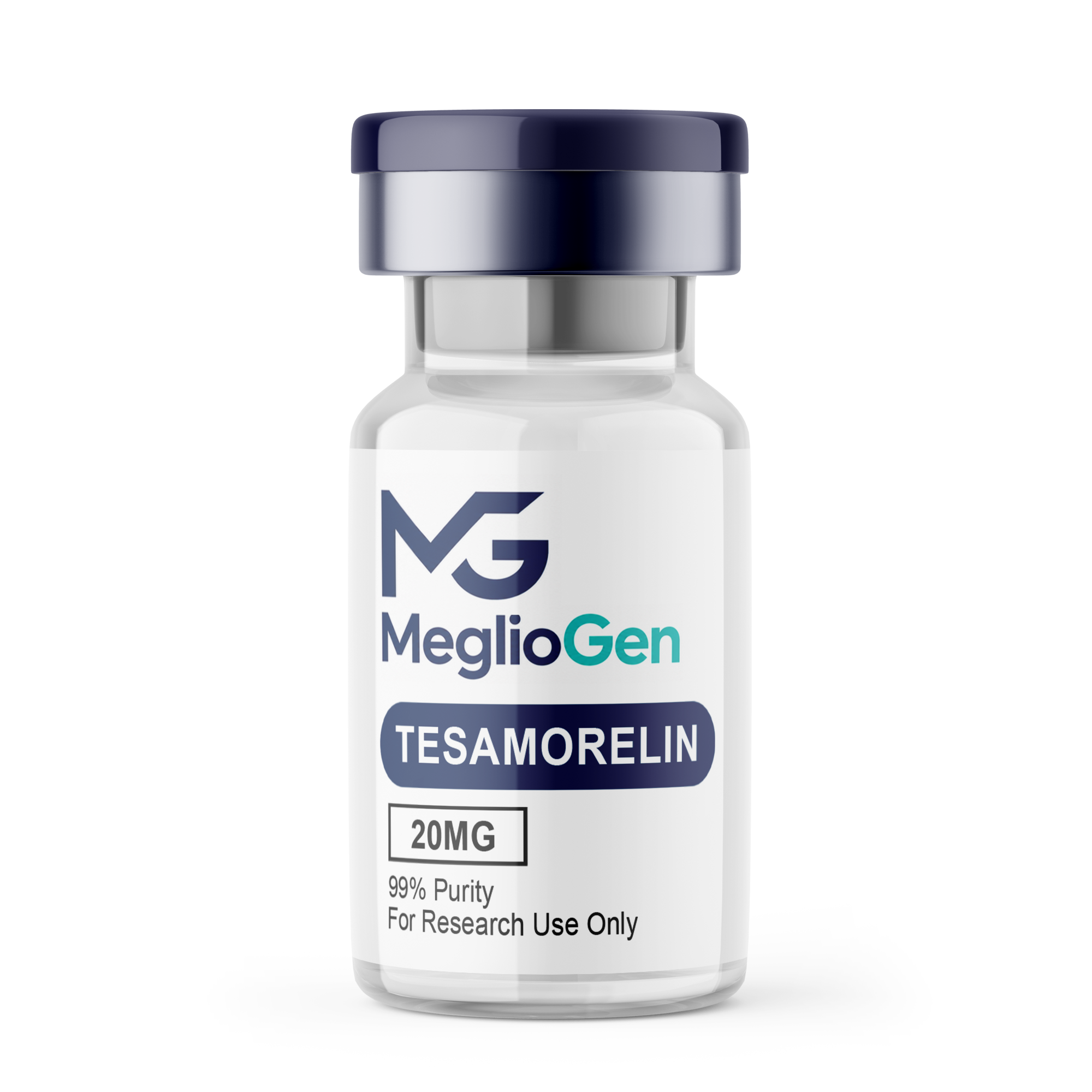
Tesamorelin 20mg is a synthetic 44-amino-acid research peptide derived from the complete sequence of human growth hormone-releasing hormone, commonly abbreviated GHRH(1–44).
The peptide contains an N-terminal trans-3-hexenoyl modification intended to increase resistance to enzymatic degradation while preserving experimental activity at the growth hormone-releasing hormone receptor, or GHRHR.
Scientific research involving tesamorelin has examined GHRHR binding, intracellular cyclic adenosine monophosphate signaling, pituitary somatotroph responses, pulsatile growth-hormone-associated pathways, insulin-like growth factor-1 signaling, body-composition models, lipid-associated pathways, and peptide stability.
Tesamorelin has also been evaluated in regulated clinical studies, and FDA-approved prescription products containing tesamorelin exist for a specific indication. However, the Tesamorelin 20mg research material offered here is not EGRIFTA®, EGRIFTA SV®, or any other approved pharmaceutical formulation.
Similarity in molecular identity does not establish pharmaceutical equivalence, sterility, bioavailability, safety, or suitability for administration.
All information provided for this product is intended exclusively for analytical, educational, and laboratory-research purposes.
Biochemical Characteristics
Tesamorelin is a synthetic analog of human GHRH(1–44) containing the complete 44-amino-acid peptide sequence with an additional trans-3-hexenoyl group attached to the N-terminal tyrosine residue.
Native GHRH is susceptible to rapid enzymatic cleavage, particularly near its N-terminal region. The trans-3-hexenoyl modification was developed to reduce susceptibility to selected proteolytic pathways while maintaining interaction with GHRHR.
The C-terminal leucine residue is amidated. The peptide also contains a methionine residue that may be susceptible to oxidation during synthesis, storage, or laboratory handling.
Biochemical characterization may include sequence confirmation, purity profiling, molecular-mass verification, GHRHR binding analysis, cAMP-response assays, oxidation assessment, aggregation analysis, and stability testing under defined laboratory conditions.
- Product Name: Tesamorelin 20mg
- Molecular Class: Synthetic GHRH peptide analog
- Primary Research Target: Growth hormone-releasing hormone receptor — GHRHR
- Receptor Class: Class B G protein-coupled receptor
- Peptide Length: 44 amino-acid residues
- N-Terminal Modification: Trans-3-hexenoyl group
- C-Terminal Modification: Amidated leucine
- Molecular Formula: C221H366N72O67S
- Approximate Molecular Weight: 5,135.9 g/mol
- CAS Number: 218949-48-5
- PubChem CID: 16137828
- Purity: Refer to the batch-specific Certificate of Analysis
- Material State: Lyophilized peptide material
- Quantity: 20mg per vial
- Intended Use: Laboratory research only
- Regulatory Status: This research product is not an FDA-approved drug
The stated molecular formula and molecular weight describe the tesamorelin molecular entity. Actual material composition may vary according to counterion, salt form, residual water, and batch-specific manufacturing characteristics.
Researchers should consult the corresponding Certificate of Analysis for definitive information concerning material identity, purity, net peptide content, and analytical methodology.
Research Applications
Within scientific literature, tesamorelin is evaluated as a stabilized synthetic GHRH analog. Its research applications include biochemical analysis, receptor-signaling studies, pituitary cell models, preclinical investigations, and comparative peptide characterization.
Documented research contexts may include:
- GHRH receptor-binding assays examining ligand affinity, receptor selectivity, potency, and concentration-dependent interaction behavior.
- Functional receptor studies measuring GHRHR activation and downstream cyclic adenosine monophosphate production.
- Pituitary somatotroph research examining receptor-mediated cellular signaling and growth-hormone-associated responses.
- GH/IGF-1 axis models investigating relationships among GHRH signaling, growth hormone, insulin-like growth factor-1, and downstream molecular pathways.
- Intracellular signaling analysis examining adenylate cyclase, cAMP, protein kinase A, CREB, and associated transcriptional pathways.
- Body-composition research evaluating tissue-specific metabolic responses in defined animal or regulated clinical-study models.
- Adipose-tissue investigations examining experimental differences between visceral and subcutaneous tissue compartments.
- Hepatic pathway research investigating lipid-associated signaling, hepatic fat measurements, gene expression, and metabolic markers.
- Peptide degradation studies examining proteolysis and the influence of the N-terminal trans-3-hexenoyl modification.
- Oxidation and stability studies evaluating methionine oxidation, deamidation, hydrolysis, and peptide aggregation.
- Comparative GHRH analog research evaluating tesamorelin alongside native GHRH, sermorelin, or other modified GHRHR ligands.
- Analytical benchmarking using chromatographic methods, mass spectrometry, peptide mapping, and validated reference standards.
All referenced applications remain confined to controlled scientific investigation. They do not constitute recommendations for clinical use, administration, compounding, or self-experimentation.
Pathway / Mechanistic Context
Tesamorelin is studied primarily as an agonist of the growth hormone-releasing hormone receptor. GHRHR is a class B G protein-coupled receptor expressed predominantly on pituitary somatotroph cells.
GHRHR Activation
In compatible experimental systems, binding of tesamorelin to GHRHR activates Gs-protein-associated signaling. This can stimulate adenylate cyclase and increase intracellular cyclic adenosine monophosphate.
The increase in cAMP may activate protein kinase A and downstream transcriptional mechanisms, including pathways involving cAMP response element-binding protein.
Growth-Hormone-Associated Signaling
GHRHR activation has been investigated in connection with growth hormone synthesis and release from pituitary somatotroph cells. Growth hormone can subsequently interact with its own receptor systems and influence insulin-like growth factor-1-associated pathways.
Tesamorelin is not growth hormone. It is studied as a GHRHR agonist whose experimental effects depend on the presence and responsiveness of the applicable receptor and downstream cellular systems.
GH/IGF-1 Axis
Research involving the GH/IGF-1 axis examines cellular growth, protein metabolism, lipid-associated pathways, glucose regulation, tissue remodeling, and numerous downstream signaling networks.
Responses within this axis may be influenced by receptor expression, endocrine feedback, experimental species, age, metabolic state, exposure duration, and assay methodology.
N-Terminal Stabilization
The trans-3-hexenoyl modification differentiates tesamorelin from native GHRH. This structural modification is intended to reduce rapid enzymatic degradation near the peptide’s N-terminus while preserving receptor-associated activity.
The modification does not eliminate all degradation pathways. Oxidation, hydrolysis, deamidation, proteolysis, and aggregation may still occur depending on storage and experimental conditions.
Mechanistic observations involving approved pharmaceutical formulations cannot independently establish the quality or behavior of an independently manufactured research product.
Preclinical Research Summary
Early biochemical and preclinical research evaluated tesamorelin as a stabilized GHRH analog capable of activating GHRHR-associated signaling. Laboratory studies examined receptor binding, cAMP accumulation, peptide degradation, and growth-hormone-related cellular responses.
Animal and clinical-development studies subsequently examined GH/IGF-1 signaling, body composition, adipose-tissue distribution, lipid-associated pathways, glucose-related markers, and hepatic experimental endpoints.
Regulated clinical studies involving sponsor-manufactured tesamorelin reported changes in visceral adipose tissue in a specific population of adults with HIV-associated lipodystrophy. Other investigations examined hepatic fat and related metabolic markers.
These findings apply to the specific pharmaceutical or investigational formulations, populations, doses, and controlled protocols examined. They cannot be attributed to an independently supplied Tesamorelin 20mg research vial.
FDA approval of a prescription tesamorelin product applies exclusively to that authorized drug, its manufacturing process, formulation, dosage, route of administration, specifications, and labeled indication.
Research involving this product does not establish:
- Pharmaceutical equivalence to EGRIFTA® or EGRIFTA SV®
- Sterility or suitability for administration
- An appropriate human or veterinary dose
- Human bioavailability or pharmacokinetics
- Clinical safety or effectiveness
- Suitability for changing growth hormone or IGF-1 levels
- Suitability for body-composition changes
- Suitability for HIV-associated lipodystrophy
- Suitability for hepatic or metabolic conditions
- Compatibility with medications or other compounds
- Short- or long-term safety
- Therapeutic, diagnostic, or preventive value
All product-specific use must remain confined to controlled laboratory, analytical, and non-clinical research environments.
Form & Analytical Testing
Tesamorelin 20mg is supplied as a research-grade synthetic peptide in lyophilized material form. Lyophilization may support stability during controlled storage but does not establish sterility, pharmaceutical quality, or suitability for administration.
Applicable analytical methods may include:
- High-Performance Liquid Chromatography — HPLC: Used to evaluate chromatographic purity and detect selected peptide-related impurities.
- Ultra-Performance Liquid Chromatography — UPLC: May provide higher-resolution separation of the principal peptide and selected degradation products.
- Liquid Chromatography–Mass Spectrometry — LC-MS: Used to support peptide identity through molecular-mass and mass-to-charge analysis.
- High-Resolution Mass Spectrometry — HRMS: May be used for precise molecular-mass confirmation.
- Peptide mapping: Used to support sequence identity and evaluate the N-terminal modification.
- Amino-acid analysis: May assist in confirming peptide composition and estimating net peptide content.
- Counterion analysis: Used to identify or quantify acetate, trifluoroacetate, or another associated counterion when applicable.
- Water-content analysis: Used to determine residual moisture contributing to total material mass.
- Residual-solvent testing: Used to evaluate selected solvents potentially remaining from peptide synthesis.
- Oxidation analysis: May be used to detect oxidation of the methionine residue or other susceptible regions.
- Stability-indicating analysis: Used to examine degradation, deamidation, hydrolysis, aggregation, and structural integrity.
- Microbial or endotoxin testing: Applicable only when specifically performed and documented for the individual batch.
A stated HPLC purity value does not independently establish net peptide content, sterility, potency, endotoxin status, stability, or pharmaceutical quality.
Researchers should review the complete batch-specific Certificate of Analysis and follow applicable institutional procedures for storage, preparation, handling, documentation, and disposal.
Referenced Citations
- Falutz, J., et al. (2007). Metabolic effects of a growth hormone-releasing factor in patients with HIV. The New England Journal of Medicine, 357, 2359–2370.
- Falutz, J., et al. (2010). Long-term safety and effects of tesamorelin in HIV-infected patients with abdominal fat accumulation. AIDS, 24(4), 543–553.
- Stanley, T. L., et al. (2014). Effect of tesamorelin on visceral fat and liver fat in HIV-infected patients with abdominal fat accumulation. JAMA, 312(4), 380–389.
- Stanley, T. L., et al. (2019). Effects of tesamorelin on non-alcoholic fatty liver disease in HIV: A randomized, double-blind, multicenter trial. The Lancet HIV, 6(12), e821–e830.
- Grunfeld, C., et al. (2010). Reduction of excess abdominal fat in HIV-infected patients with lipodystrophy using tesamorelin. Journal of Acquired Immune Deficiency Syndromes, 53(3), 311–322.
- Mayo, K. E., et al. Research concerning the structure, receptor activity, and physiological signaling of growth hormone-releasing hormone.
- National Center for Biotechnology Information. PubChem Compound Summary: Tesamorelin. PubChem CID 16137828.
- U.S. Food and Drug Administration. Tesamorelin pharmaceutical prescribing and regulatory documentation.
ALL ARTICLES AND PRODUCT INFORMATION PROVIDED ON THIS WEBSITE ARE FOR INFORMATIONAL, EDUCATIONAL, AND LABORATORY-RESEARCH PURPOSES ONLY. THEY ARE NOT INTENDED TO PROVIDE MEDICAL OR VETERINARY ADVICE.
RUO Disclaimer
Tesamorelin 20mg is intended strictly for laboratory, analytical, and scientific research purposes.
Although tesamorelin is the active ingredient in an FDA-approved prescription medication, the research-grade product offered on this website is not EGRIFTA®, EGRIFTA SV®, or any other authorized pharmaceutical formulation.
This material has not been established as pharmaceutically equivalent, bioequivalent, sterile, clinically interchangeable, or suitable for administration. The existence of an approved tesamorelin medication does not extend regulatory approval to independently supplied research materials.
This product is not intended for:
- Human consumption or administration
- Veterinary use
- Compounding
- Self-experimentation
- Body-composition modification
- Hormonal manipulation
- Clinical or diagnostic use
- Food, beverage, or cosmetic preparation
- Treatment, mitigation, cure, or prevention of disease
- Substitution for an approved prescription medication
For Laboratory Research Use Only (RUO). Not for human use, medical use, diagnostic use, or veterinary use.
Reviews
There are no reviews yet.