
Overview
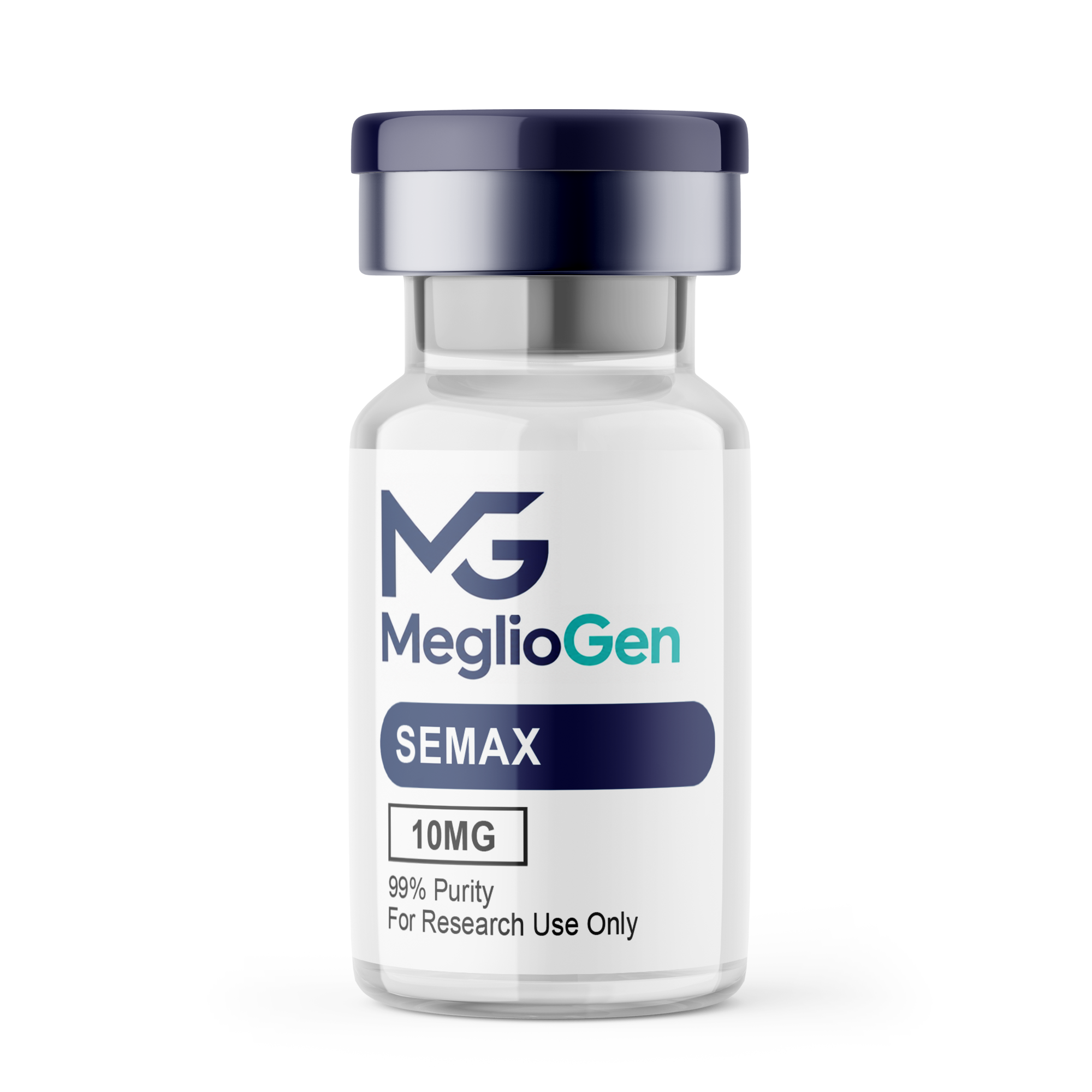
Semax 10mg is a synthetic research heptapeptide derived from the amino-acid sequence of adrenocorticotropic hormone fragment ACTH(4–7) and extended at the C-terminus with the tripeptide Pro‑Gly‑Pro.
Its complete sequence is Met‑Glu‑His‑Phe‑Pro‑Gly‑Pro. The peptide was developed for experimental investigation of ACTH-fragment-associated signaling while minimizing the direct hormonal activity associated with full-length adrenocorticotropic hormone.
Scientific research involving Semax has examined neurotrophin-related gene expression, neuronal signaling, cellular responses to experimental stress, inflammatory mediators, oxidative pathways, neurotransmitter-associated systems, and molecular responses in models of cerebral ischemia.
The available literature includes biochemical studies, cultured-cell experiments, animal models, and limited clinical research conducted outside the United States. Findings from these studies are specific to the tested formulations, research protocols, and experimental conditions.
Semax is not approved by the U.S. Food and Drug Administration. Semax 10mg is supplied strictly as a laboratory-research material and is not intended for human or veterinary use.
Biochemical Characteristics
Semax is a synthetic linear heptapeptide consisting of seven amino-acid residues. Its N-terminal Met‑Glu‑His‑Phe sequence corresponds to ACTH(4–7), while the Pro‑Gly‑Pro extension is intended to influence peptide stability and biological activity in experimental systems.
Unlike full-length ACTH, Semax has not been characterized as producing the same direct corticosteroid-stimulating activity. Research instead focuses on its interaction with neurotrophin-associated pathways, neurotransmitter systems, inflammatory signaling, gene transcription, and cellular responses to controlled neurological challenges.
Biochemical characterization may include peptide-identity confirmation, sequence analysis, chromatographic purity assessment, molecular-mass verification, degradation profiling, and stability testing under defined laboratory conditions.
- Product Name: Semax 10mg
- Alternative Identification: ACTH(4–7)‑Pro‑Gly‑Pro
- Peptide Sequence: Met‑Glu‑His‑Phe‑Pro‑Gly‑Pro
- One-Letter Sequence: MEHFPGP
- Molecular Class: Synthetic linear heptapeptide
- Peptide Length: Seven amino-acid residues
- Molecular Formula: C37H51N9O10S
- Approximate Molecular Weight: 813.9 g/mol
- PubChem CID: 9811102
- Purity: Refer to the batch-specific Certificate of Analysis
- Material State: Lyophilized peptide material
- Quantity: 10mg per vial
- Intended Use: Laboratory research only
- Regulatory Status: Not an FDA-approved drug
The stated molecular formula and molecular weight describe the unsalted Semax molecular entity. Actual material composition may vary according to counterion, residual water, salt form, and batch-specific manufacturing characteristics.
Researchers should rely on the applicable Certificate of Analysis for definitive information concerning identity, purity, net peptide content, and material composition.
Research Applications
Within scientific literature, Semax is evaluated as an experimental ACTH-derived peptide in neurological, biochemical, molecular, and cellular research systems.
Documented laboratory research contexts may include:
- Neurotrophin-expression studies examining experimental changes in brain-derived neurotrophic factor, nerve growth factor, and their associated receptors.
- Gene-transcription research evaluating changes in messenger RNA and gene-expression patterns following peptide exposure.
- Neuronal signaling studies examining intracellular pathways and communication between neuronal cell populations.
- Experimental cerebral-ischemia models evaluating molecular and cellular responses to controlled reductions in cerebral blood flow.
- Cellular stress-response studies examining neuronal survival markers, apoptosis-related pathways, and adaptive cellular signaling.
- Inflammatory-signaling research evaluating cytokines, chemokines, immune-associated genes, and inflammation-related transcriptional pathways.
- Oxidative-pathway investigations examining antioxidant-response systems, oxidative markers, and cellular redox balance.
- Neurotransmitter-associated research involving experimental dopaminergic, serotonergic, cholinergic, and glutamatergic systems.
- Peptide-metabolism studies examining enzymatic degradation and the formation of shorter peptide fragments.
- Comparative ACTH-fragment research evaluating Semax alongside ACTH(4–7), Pro‑Gly‑Pro, or other synthetic peptide analogs.
- Peptide stability analysis examining degradation, oxidation, aggregation, and structural integrity under controlled storage conditions.
- Analytical benchmarking using chromatographic methods, mass spectrometry, peptide mapping, and validated reference standards.
All referenced applications remain confined to laboratory and non-clinical experimental contexts. They do not establish therapeutic effectiveness, clinical safety, an appropriate dose, or suitability for human or veterinary administration.
Pathway / Mechanistic Context
Semax does not have one fully established molecular target comparable to a highly selective receptor ligand. Its experimental activity has instead been investigated across several interconnected neuronal and molecular signaling systems.
Neurotrophin-Associated Signaling
Animal research has reported changes in the expression of brain-derived neurotrophic factor and other neurotrophin-associated genes following Semax exposure. Neurotrophins participate in neuronal development, cellular survival, synaptic organization, and adaptive signaling.
These findings represent changes observed in specific experimental models and do not demonstrate cognitive enhancement or neurological benefit in humans.
Gene-Expression Context
Transcriptomic investigations have examined Semax-associated changes in genes involved in inflammatory signaling, vascular function, immune activity, neurotransmission, and cellular stress responses.
Gene-expression changes can vary according to tissue type, animal model, exposure time, concentration, and experimental challenge. A change in messenger RNA does not necessarily produce a corresponding functional or physiological outcome.
ACTH-Fragment Context
The Met‑Glu‑His‑Phe portion of Semax corresponds to ACTH(4–7). This sequence has been studied separately from the steroidogenic regions of full-length ACTH. The Pro‑Gly‑Pro extension may alter enzymatic stability and contribute additional peptide-fragment interactions.
Neurotransmitter-Associated Context
Preclinical investigations have explored relationships between Semax and dopaminergic, serotonergic, cholinergic, and glutamatergic signaling. These proposed relationships remain model-dependent and do not establish a single validated receptor mechanism.
Experimental Stress and Ischemia Context
Semax has been studied in animal models of cerebral ischemia and other controlled neurological challenges. Investigators have examined neurotrophin transcription, inflammatory mediators, cellular survival pathways, vascular-associated genes, and oxidative responses.
Results from experimentally induced animal models cannot be directly translated into treatment claims or expected human outcomes.
Preclinical Research Summary
A substantial portion of Semax research consists of animal investigations examining molecular responses in the brain. One frequently referenced rat study reported changes in brain-derived neurotrophic factor expression in several brain regions following Semax exposure.
Additional animal research involving experimental cerebral ischemia examined transcriptional changes involving neurotrophins and their receptors. Other studies have investigated immune-associated genes, inflammatory mediators, vascular pathways, neurotransmitter systems, and cellular stress-response mechanisms.
Some published investigations have evaluated Semax in human research outside the United States. However, these studies do not establish that independently manufactured Semax 10mg is equivalent to any material used in those investigations.
Differences in sequence verification, purity, counterion, formulation, excipients, manufacturing controls, storage, analytical testing, and experimental administration can substantially affect research outcomes.
Research involving this product does not establish:
- Pharmaceutical equivalence to material used in published studies
- Sterility or suitability for administration
- An appropriate human or veterinary dose
- Human bioavailability or pharmacokinetics
- Clinical safety or effectiveness
- Cognitive enhancement
- Neuroprotective efficacy in humans
- Suitability for neurological or psychiatric conditions
- Compatibility with medications or other compounds
- Short- or long-term safety
- Therapeutic, diagnostic, or preventive value
All product-specific use must remain confined to controlled laboratory, analytical, and non-clinical research environments.
Form & Analytical Testing
Semax 10mg is supplied as a research-grade synthetic peptide in lyophilized material form. Lyophilization may support stability during controlled storage but does not establish sterility, pharmaceutical quality, or suitability for administration.
Applicable analytical methods may include:
- High-Performance Liquid Chromatography — HPLC: Used to evaluate chromatographic purity and detect selected peptide-related impurities.
- Ultra-Performance Liquid Chromatography — UPLC: May provide higher-resolution separation of the principal peptide and selected degradation products.
- Liquid Chromatography–Mass Spectrometry — LC-MS: Used to support molecular identity through mass-to-charge analysis.
- High-Resolution Mass Spectrometry — HRMS: May be used for precise molecular-mass confirmation.
- Peptide mapping: Used to support sequence identity and detect selected sequence-related variants.
- Amino-acid analysis: May assist in confirming peptide composition and estimating net peptide content.
- Counterion analysis: Used to identify or quantify acetate, trifluoroacetate, or another associated counterion when applicable.
- Water-content analysis: Used to determine residual moisture contributing to total material mass.
- Residual-solvent testing: Used to evaluate selected solvents potentially remaining from peptide synthesis.
- Stability-indicating analysis: Used to examine oxidation, hydrolysis, aggregation, and enzymatic degradation.
- Microbial or endotoxin testing: Applicable only when specifically performed and documented for the individual batch.
A stated chromatographic purity value does not independently establish net peptide content, sterility, potency, endotoxin status, stability, or pharmaceutical quality.
Researchers should review the complete batch-specific Certificate of Analysis and follow applicable institutional procedures for storage, preparation, handling, documentation, and disposal.
Referenced Citations
- Dolotov, O. V., et al. (2003). The heptapeptide Semax stimulates BDNF expression in different areas of the rat brain in vivo. Doklady Biological Sciences, 391, 292–295. PubMed.
- Medvedeva, E. V., et al. (2010). Semax and Pro‑Gly‑Pro activate the transcription of neurotrophins and their receptor genes after cerebral ischemia. Cellular and Molecular Neurobiology, 30, 71–79. Full text.
- Ashmarin, I. P., et al. Research concerning ACTH(4–7), Pro‑Gly‑Pro peptides, and the development of Semax-associated experimental models.
- Myasoedov, N. F., et al. Studies concerning Semax peptide biology, neurological experimental systems, and ACTH-fragment-associated signaling.
- Kolomin, T., et al. Investigations of Semax degradation products and the biological activity of Pro‑Gly‑Pro-associated peptide fragments.
- Shadrina, M. I., et al. Gene-expression analysis following Semax exposure in experimental cerebral-ischemia models.
- National Center for Biotechnology Information. PubChem Compound Summary: ACTH(4–7), Pro‑Gly‑Pro—Semax. PubChem CID 9811102.
ALL ARTICLES AND PRODUCT INFORMATION PROVIDED ON THIS WEBSITE ARE FOR INFORMATIONAL, EDUCATIONAL, AND LABORATORY-RESEARCH PURPOSES ONLY. THEY ARE NOT INTENDED TO PROVIDE MEDICAL OR VETERINARY ADVICE.
RUO Disclaimer
Semax 10mg is intended strictly for laboratory, analytical, and scientific research purposes.
Semax is not approved by the U.S. Food and Drug Administration as a drug, dietary supplement, food ingredient, cosmetic product, medical device, or therapeutic formulation.
This independently supplied research material has not been established as pharmaceutically equivalent to any formulation used in published animal or human studies. It has not been established as sterile, bioequivalent, clinically interchangeable, or suitable for administration.
This product is not intended for:
- Human consumption or administration
- Veterinary use
- Intranasal or injectable use
- Compounding
- Self-experimentation
- Cognitive or performance enhancement
- Clinical or diagnostic use
- Food, beverage, or cosmetic preparation
- Treatment, mitigation, cure, or prevention of disease
- Substitution for a prescription or authorized pharmaceutical product
For Laboratory Research Use Only (RUO). Not for human use, medical use, diagnostic use, or veterinary use.
Reviews
There are no reviews yet.