
Overview
Semaglutide 15mg is a synthetic, modified glucagon-like peptide-1 analog investigated for its interaction with the glucagon-like peptide-1 receptor, commonly abbreviated GLP-1R.
Native GLP-1 is an incretin peptide involved in glucose-responsive cellular communication and multiple metabolic signaling pathways. Semaglutide incorporates structural modifications intended to reduce enzymatic degradation, promote albumin association, and extend its experimental exposure characteristics compared with native GLP-1.
Scientific investigations involving semaglutide include receptor-binding assays, cultured-cell systems, preclinical animal models, pharmacokinetic analyses, and controlled clinical studies. Research has examined GLP-1R activation, intracellular cyclic adenosine monophosphate production, glucose-responsive signaling, pancreatic cellular activity, gastrointestinal communication, neuronal pathways, and energy-regulation mechanisms.
Although FDA-approved prescription medications contain semaglutide as their active ingredient, the Semaglutide 15mg research material offered here is not an approved pharmaceutical product. Molecular similarity does not establish pharmaceutical equivalence, sterility, bioavailability, safety, or suitability for administration.
All information is provided exclusively for analytical, educational, and laboratory-research purposes. No claims are made regarding therapeutic efficacy, clinical outcomes, dosing, or suitability for human or veterinary use.
Biochemical Characteristics
Semaglutide is a modified GLP-1 analog with approximately 94% sequence homology to native human GLP-1. Its molecular design incorporates several modifications that distinguish it from the naturally occurring peptide.
These modifications include substitution of alanine with 2-aminoisobutyric acid at a position susceptible to dipeptidyl peptidase-4 activity, an amino-acid substitution intended to support site-specific modification, and attachment of a fatty diacid-containing side chain through a hydrophilic spacer.
In experimental systems, the fatty-acid-associated side chain promotes reversible albumin binding, while the modified peptide sequence reduces susceptibility to selected enzymatic degradation pathways. These characteristics contribute to its prolonged pharmacokinetic profile in sponsor-manufactured pharmaceutical and clinical-study formulations.
Biochemical characterization may include peptide-identity confirmation, chromatographic purity analysis, molecular-mass verification, GLP-1R binding assessment, functional signaling assays, and evaluation of structural stability under defined laboratory conditions.
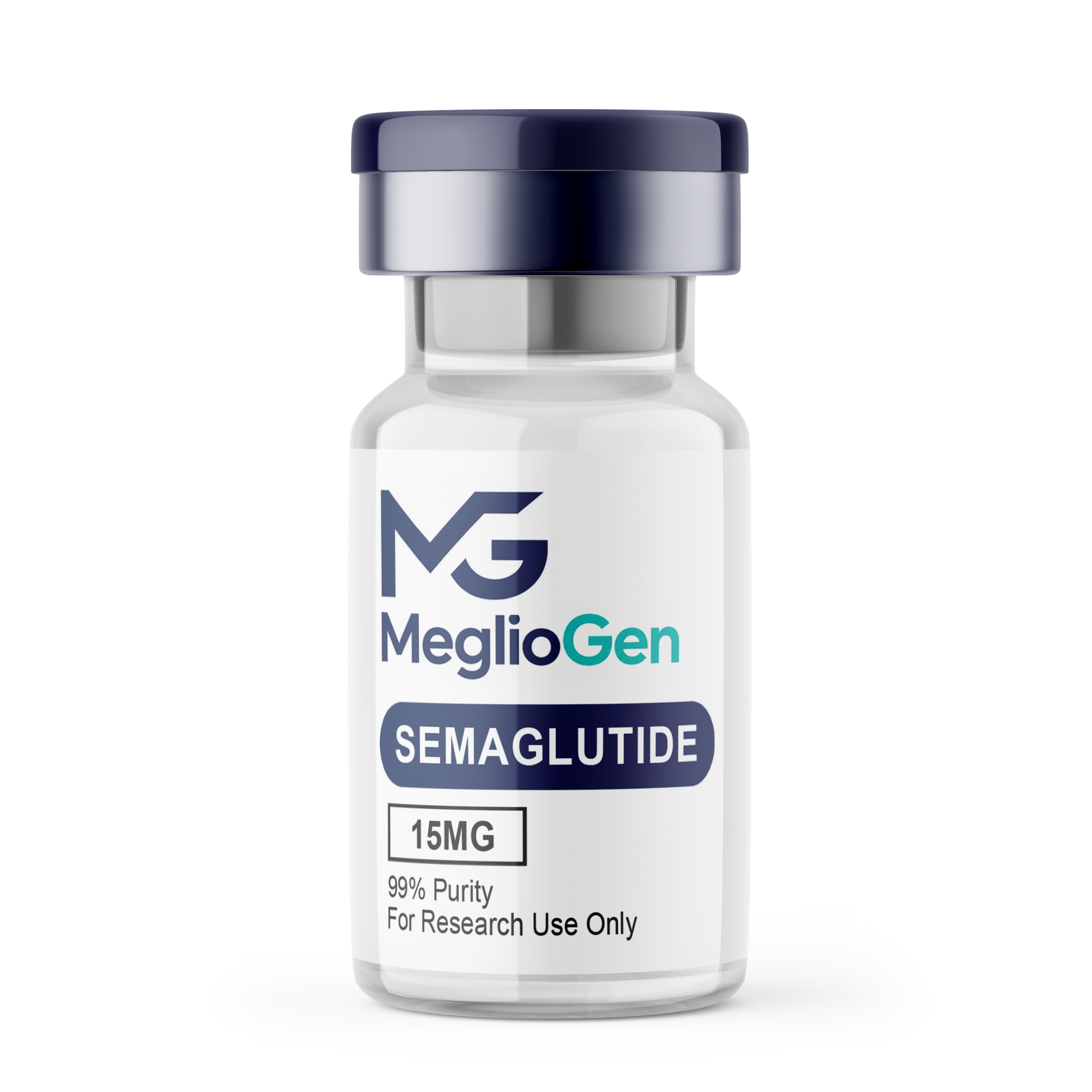
- Product Name: Semaglutide 15mg
- Molecular Class: Synthetic GLP-1 peptide analog
- Primary Research Target: Glucagon-like peptide-1 receptor — GLP-1R
- Receptor Profile: GLP-1R agonist
- Peptide Length: 31 amino-acid residues
- Molecular Formula: C187H291N45O59
- Approximate Molecular Weight: 4,113.6 g/mol
- Peptide Composition: Modified and lipidated GLP-1 analog
- Purity: Refer to the batch-specific Certificate of Analysis
- Material State: Lyophilized peptide material
- Quantity: 15mg per vial
- Intended Use: Laboratory research only
- Regulatory Status: This research product is not an FDA-approved drug
The stated molecular formula and molecular weight describe the semaglutide molecular entity. Actual material mass and composition may be affected by counterions, salt form, residual moisture, excipients, and batch-specific manufacturing characteristics.
Researchers should consult the corresponding Certificate of Analysis for definitive information concerning identity, purity, material content, and analytical methodology.
Research Applications
Within scientific literature, semaglutide is investigated as a modified GLP-1 analog with activity at GLP-1R. Its research applications include biochemical analysis, cellular signaling studies, preclinical investigations, and comparative peptide characterization.
Documented laboratory research contexts may include:
- GLP-1 receptor-binding assays examining ligand affinity, receptor selectivity, potency, and concentration-dependent interaction behavior.
- Functional receptor studies measuring GLP-1R activation and downstream cyclic adenosine monophosphate production.
- Intracellular signaling analysis examining protein-kinase activation, transcriptional responses, and other pathways associated with GLP-1R signaling.
- Glucose-responsive cellular models evaluating receptor-mediated activity under different experimental glucose conditions.
- Pancreatic islet-cell research examining GLP-1-associated signaling in defined cellular or tissue preparations.
- Neuronal pathway studies investigating GLP-1R expression and signaling within experimental central nervous system models.
- Gastrointestinal signaling research examining receptor-mediated communication, cellular responses, and experimental motility-associated pathways.
- Energy-regulation models evaluating signaling pathways associated with food-intake behavior, energy balance, and metabolic regulation in experimental animals.
- Peptide stability studies evaluating enzymatic degradation, structural integrity, oxidation, aggregation, and temperature-dependent behavior.
- Albumin-binding investigations examining the effect of semaglutide’s lipid-associated side chain on protein binding and experimental exposure.
- Comparative GLP-1 analog research evaluating semaglutide alongside native GLP-1 or other modified receptor agonists.
- Analytical benchmarking using chromatographic methods, mass spectrometry, peptide mapping, and validated reference materials.
These applications are presented strictly as scientific research contexts. They do not constitute recommendations for clinical use, administration, compounding, or self-experimentation.
Pathway / Mechanistic Context
Semaglutide is studied primarily as an agonist of GLP-1R, a class B G protein-coupled receptor expressed in multiple cellular and tissue systems.
When semaglutide binds to GLP-1R in compatible experimental systems, receptor activation can stimulate G protein-mediated adenylate cyclase activity and increase intracellular cyclic adenosine monophosphate. This signaling event may engage protein kinase A, exchange proteins activated by cAMP, ion-channel regulation, and downstream transcriptional pathways.
Experimental GLP-1R activity has been investigated in connection with:
- Glucose-responsive intracellular signaling
- Pancreatic beta-cell activity
- Insulin-associated signaling under defined experimental conditions
- Glucagon-associated cellular responses
- Gastrointestinal communication pathways
- Neuronal and hypothalamic signaling
- Food-intake behavior in animal models
- Energy-balance regulation
- Cardiovascular and renal experimental pathways
- Cellular inflammatory and oxidative-stress responses
Semaglutide contains a fatty diacid-associated side chain designed to promote reversible albumin binding. Albumin association and resistance to selected enzymatic degradation pathways influence the compound’s experimental distribution and persistence.
Observed responses may vary depending on receptor-expression level, cell type, species, ligand concentration, glucose conditions, exposure duration, assay methodology, and material quality.
Mechanistic observations involving approved pharmaceutical formulations or sponsor-manufactured clinical materials cannot establish equivalence or suitability of an independently supplied research product.
Preclinical Research Summary
Preclinical research has evaluated semaglutide in receptor-binding systems, cultured cells, and experimental animal models. Early investigations characterized its GLP-1R activity, resistance to dipeptidyl peptidase-4 degradation, albumin-binding properties, and extended experimental exposure.
Animal models have examined semaglutide-associated activity in glucose regulation, pancreatic signaling, food-intake behavior, energy balance, body composition, cardiovascular pathways, renal systems, and other metabolic research contexts.
Semaglutide has also undergone extensive regulated clinical investigation, and multiple prescription medications containing semaglutide have received FDA approval for specific indications, formulations, dosages, and patient populations.
Those approvals apply exclusively to the authorized pharmaceutical products manufactured under approved specifications. They do not apply to Semaglutide 15mg marketed as a laboratory-research material.
The independently supplied research product has not been established as equivalent to Ozempic®, Wegovy®, Rybelsus®, or any other approved semaglutide formulation.
Research involving this product does not establish:
- Pharmaceutical equivalence to an approved medication
- Sterility or suitability for administration
- An appropriate human or veterinary dose
- Human bioavailability or pharmacokinetics
- Clinical safety or effectiveness
- Long-term safety
- Compatibility with medications or other research compounds
- Suitability for diabetes or weight management
- Suitability for cardiovascular, renal, or metabolic conditions
- Therapeutic, diagnostic, or preventive value
All product-specific use must remain confined to controlled laboratory, analytical, and non-clinical research environments.
Form & Analytical Testing
Semaglutide 15mg is supplied as a research-grade synthetic peptide in lyophilized material form. Lyophilization can support material stability during controlled storage but does not establish sterility, pharmaceutical quality, or suitability for administration.
Applicable analytical methods may include:
- High-Performance Liquid Chromatography — HPLC: Used to evaluate chromatographic purity and detect selected peptide-related impurities.
- Ultra-Performance Liquid Chromatography — UPLC: May provide higher-resolution analysis of the principal compound and selected degradation products.
- Liquid Chromatography–Mass Spectrometry — LC-MS: Used to support peptide identity through molecular-mass and mass-to-charge analysis.
- High-Resolution Mass Spectrometry — HRMS: May be used for more precise molecular-mass confirmation.
- Peptide mapping: Used to support sequence identity and detect selected sequence-related variants.
- Amino-acid analysis: May assist in evaluating peptide composition and net peptide content.
- Counterion analysis: Used to identify or quantify acetate, trifluoroacetate, or another associated counterion when applicable.
- Water-content analysis: Used to determine residual moisture contributing to total material mass.
- Residual-solvent testing: Used to evaluate selected solvents potentially remaining from synthesis or processing.
- Stability-indicating analysis: Used to examine oxidation, deamidation, aggregation, hydrolysis, and other degradation pathways.
- Microbial or endotoxin testing: Relevant only when specifically performed and documented for the individual batch.
A reported HPLC purity value does not independently establish net peptide content, sterility, potency, endotoxin status, stability, or pharmaceutical quality.
The presence of 15mg of labeled material does not establish that the vial is suitable for administration. Researchers should review the complete batch-specific Certificate of Analysis and follow applicable institutional procedures for laboratory storage, preparation, handling, documentation, and disposal.
Referenced Citations
- Lau, J., et al. (2015). Discovery of the once-weekly glucagon-like peptide-1 analog semaglutide. Journal of Medicinal Chemistry, 58(18), 7370–7380. PubMed.
- Kapoor, R., et al. (2018). Clinical pharmacology of semaglutide: A systematic review. Diabetes Therapy, 9, 25–38.
- Marso, S. P., et al. (2016). Semaglutide and cardiovascular outcomes in patients with type 2 diabetes. The New England Journal of Medicine, 375, 1834–1844.
- Sorli, C., et al. (2017). Efficacy and safety of once-weekly semaglutide monotherapy versus placebo in patients with type 2 diabetes. The Lancet Diabetes & Endocrinology, 5(4), 251–260.
- Wilding, J. P. H., et al. (2021). Once-weekly semaglutide in adults with overweight or obesity. The New England Journal of Medicine, 384, 989–1002.
- Rubino, D., et al. (2021). Effect of continued weekly semaglutide versus withdrawal on weight-loss maintenance in adults with overweight or obesity. JAMA, 325(14), 1414–1425.
- Davies, M., et al. (2021). Semaglutide 2.4mg once a week in adults with overweight or obesity and type 2 diabetes. The Lancet, 397, 971–984.
- Drucker, D. J. (2018). Mechanisms of action and therapeutic application of glucagon-like peptide-1. Cell Metabolism, 27(4), 740–756.
- Müller, T. D., et al. (2019). Glucagon-like peptide 1. Molecular Metabolism, 30, 72–130.
- U.S. Food and Drug Administration. Semaglutide pharmaceutical prescribing information and regulatory documentation.
ALL ARTICLES AND PRODUCT INFORMATION PROVIDED ON THIS WEBSITE ARE FOR INFORMATIONAL, EDUCATIONAL, AND LABORATORY-RESEARCH PURPOSES ONLY. THEY ARE NOT INTENDED TO PROVIDE MEDICAL OR VETERINARY ADVICE.
RUO Disclaimer
Semaglutide 15mg is intended strictly for laboratory, analytical, and scientific research purposes.
Although semaglutide is the active ingredient in certain FDA-approved prescription medications, the research-grade product offered on this website is not Ozempic®, Wegovy®, Rybelsus®, or any other approved pharmaceutical product.
This material has not been established as pharmaceutically equivalent, bioequivalent, sterile, clinically interchangeable, or suitable for administration. The existence of approved semaglutide medications does not extend regulatory approval to independently supplied research materials.
This product is not intended for:
- Human consumption or administration
- Veterinary use
- Compounding
- Self-experimentation
- Clinical or diagnostic use
- Food, beverage, or cosmetic preparation
- Weight-management use
- Diabetes management
- Treatment, mitigation, cure, or prevention of disease
- Substitution for an approved prescription medication
For Laboratory Research Use Only (RUO). Not for human use, medical use, diagnostic use, or veterinary use.
Reviews
There are no reviews yet.