
Overview
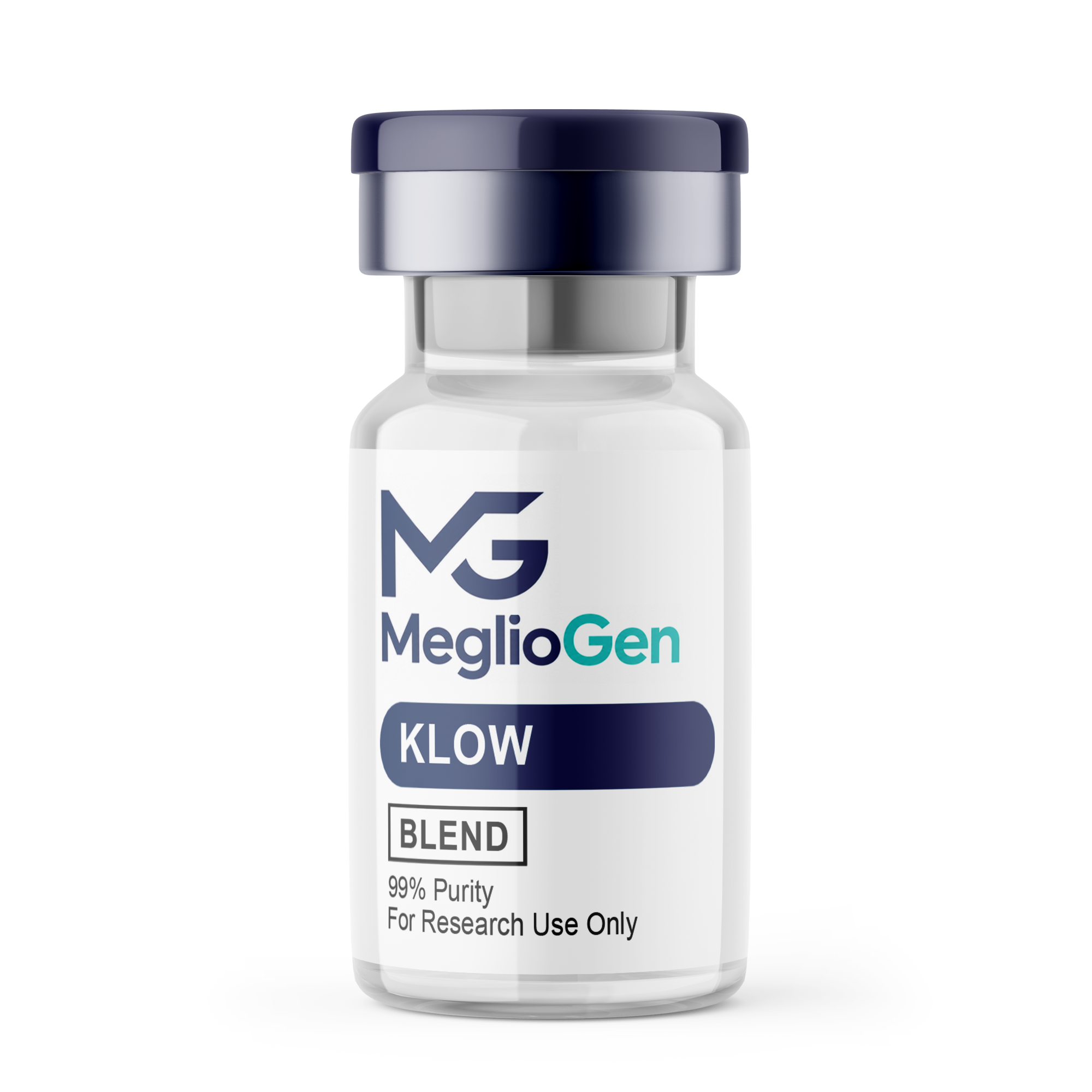
KLOW is a synthetic multi-peptide research formulation combining four independently studied compounds:
- KPV — 10mg
- BPC‑157 — 10mg
- TB‑500 — 10mg
- GHK‑Cu — 50mg
- Total labeled active content — 80mg
The blend is intended for laboratory investigation of molecular pathways associated with inflammatory signaling, cellular migration, angiogenesis, extracellular-matrix organization, collagen-related activity, and experimental tissue-remodeling processes.
Each component has been independently examined in laboratory or preclinical research. However, evidence relating to an individual component cannot automatically be attributed to the complete KLOW formulation. The precise biological interactions, compatibility, stability, and combined activity of all four components require independent experimental evaluation.
No peer-reviewed clinical study has established the safety, efficacy, pharmacokinetics, or therapeutic utility of this exact blend.
All available information is presented exclusively for analytical, educational, and laboratory-research purposes. KLOW is not intended for human consumption or clinical application.
Biochemical Characteristics
KLOW combines structurally and functionally distinct research compounds within a single experimental formulation.
KPV
KPV is a short tripeptide with the amino-acid sequence Lys‑Pro‑Val. It corresponds to the C-terminal sequence of alpha-melanocyte-stimulating hormone, commonly abbreviated α‑MSH.
Laboratory studies have examined KPV in relation to inflammatory signaling, immune-cell activity, cytokine expression, and epithelial experimental models. These findings remain dependent on the specific cell, animal, concentration, and research protocol employed.
BPC‑157
BPC‑157 is a synthetic 15-amino-acid research peptide. Preclinical studies have explored it in experimental models involving cellular migration, angiogenic signaling, gastrointestinal tissues, fibroblast activity, tendons, ligaments, and other connective-tissue systems.
Published evidence is predominantly derived from animal or laboratory models. Human safety, efficacy, dosing, and pharmacokinetic characteristics have not been adequately established.
TB‑500
TB‑500 is a synthetic research material associated with thymosin beta‑4-related investigations. Thymosin beta‑4 research has examined actin regulation, cellular migration, angiogenic activity, inflammatory signaling, and experimental tissue-remodeling processes.
The term “TB‑500” is not always used consistently across commercial and research materials. Researchers must consult the product’s batch-specific documentation to confirm its sequence, identity, and relationship to full-length thymosin beta‑4. Findings involving thymosin beta‑4 should not automatically be attributed to every material marketed as TB‑500.
GHK‑Cu
GHK‑Cu is a naturally occurring copper-binding tripeptide complex composed of glycyl‑L‑histidyl‑L‑lysine coordinated with copper.
Laboratory research has investigated GHK‑Cu in connection with copper transport, extracellular-matrix signaling, collagen-associated activity, cellular migration, gene-expression patterns, angiogenesis, and experimental tissue-remodeling systems.
Its copper-bound state makes identity, stoichiometry, oxidation conditions, and handling relevant to experimental interpretation.
Product Characteristics
- Product Name: KLOW
- Molecular Class: Multi-component peptide research blend
- KPV Content: 10mg
- BPC‑157 Content: 1mg
- TB‑500 Content: 10mg
- GHK‑Cu Content: 50mg
- Total Labeled Active Content: 71mg
- Material Form: Research-grade blended material
- Research Grade: High-purity laboratory material
- Intended Use: Laboratory research only
- Regulatory Status: Not approved as a drug, dietary supplement, cosmetic, food ingredient, or therapeutic product
Because KLOW contains multiple chemically distinct components, it should not be assigned a single molecular formula or molecular weight. Each constituent retains its own chemical identity and analytical characteristics.
Research Applications
KLOW is intended for controlled laboratory investigations in which researchers require multiple peptide-related targets within a defined experimental formulation.
Potential research contexts may include:
- Inflammatory-signaling studies examining cytokine expression, transcriptional activity, immune-cell responses, and inflammatory pathway modulation.
- Cellular-migration assays evaluating the movement and organization of fibroblasts, endothelial cells, epithelial cells, or other defined cell populations.
- Extracellular-matrix research examining collagen-associated signaling, matrix organization, fibroblast activity, and related biochemical markers.
- Angiogenic-signaling models evaluating endothelial responses, vascular-associated markers, and experimental blood-vessel formation pathways.
- Tissue-remodeling investigations studying cellular responses following controlled mechanical, chemical, or inflammatory challenges.
- Epithelial barrier models examining laboratory markers associated with barrier integrity and inflammatory responses.
- Actin-regulation studies involving cytoskeletal organization, cell motility, and thymosin beta‑4-related pathways.
- Copper-peptide research examining copper coordination, oxidative conditions, gene-expression patterns, and extracellular-matrix activity.
- Comparative peptide studies evaluating KLOW against its individual constituents or other experimental controls.
- Combination-effect investigations examining whether the components demonstrate additive, antagonistic, synergistic, or concentration-dependent activity.
Reference applications are strictly limited to laboratory and non-clinical experimentation. No experimental application described here represents a recommendation for human or veterinary use.
Pathway / Mechanistic Context
KLOW is designed as a multi-pathway research formulation rather than a single-target compound. Its constituents may interact with different biochemical processes under controlled experimental conditions.
KPV-Associated Context
KPV has been investigated in connection with α‑MSH-related anti-inflammatory signaling. Experimental research has examined its potential influence on cytokine production, NF‑κB-associated activity, immune-cell responses, and epithelial inflammatory models.
BPC‑157-Associated Context
Preclinical BPC‑157 investigations have examined pathways involving cellular migration, endothelial activity, nitric-oxide-associated signaling, fibroblast responses, angiogenesis, and experimental tissue organization.
The mechanisms proposed in the literature remain investigational and have not been validated as clinical mechanisms in humans.
TB‑500-Associated Context
Thymosin beta‑4-related research has focused on actin sequestration, cytoskeletal organization, cell motility, endothelial-cell migration, inflammatory responses, and experimental tissue-remodeling processes.
These observations may not apply identically to every product identified as TB‑500. Sequence confirmation is essential when interpreting experimental findings.
GHK‑Cu-Associated Context
GHK‑Cu research has examined copper transport, extracellular-matrix signaling, metalloproteinase regulation, collagen-associated pathways, angiogenic activity, antioxidant-response systems, and gene-expression patterns.
The behavior of GHK‑Cu may be influenced by pH, buffer composition, copper availability, oxidation state, light exposure, temperature, and interactions with other blend components.
Combined-Blend Context
When combined, the four components may display biochemical behavior that differs from that observed when each material is studied independently. Possible factors include:
- Competitive or complementary pathway activity
- Changes in solubility or stability
- Copper-mediated oxidation
- Peptide aggregation or degradation
- Concentration-dependent interactions
- Altered chromatographic behavior
- Changes in cellular uptake
- Assay-specific interference
These possible interactions must be evaluated experimentally. Independent studies involving KPV, BPC‑157, thymosin beta‑4-related materials, or GHK‑Cu do not establish the properties of the combined KLOW blend.
Preclinical Research Summary
KPV has been examined in laboratory research concerning the anti-inflammatory activity of α‑MSH-derived sequences. One frequently referenced study compared the core and C-terminal sequences of α‑MSH and evaluated KPV-associated inflammatory responses in experimental systems. PubMed
BPC‑157 has been investigated primarily in animal models involving gastrointestinal tissues, tendons, ligaments, blood vessels, and other experimental injury systems. While preclinical studies report biological activity, the available evidence does not establish human efficacy, approved dosage, or clinical safety.
Research involving thymosin beta‑4 has evaluated cellular migration, actin regulation, angiogenesis, inflammatory responses, and dermal experimental models. However, thymosin beta‑4 and commercial TB‑500 terminology should not be treated as universally interchangeable without confirmation of the tested material’s sequence and identity. PubMed
GHK‑Cu has been studied in cellular and animal models involving extracellular-matrix remodeling, collagen-associated activity, angiogenesis, cellular proliferation, and gene-expression responses. A mouse model using GHK‑Cu liposomes reported changes in cellular proliferation and angiogenic markers; those findings apply only to the formulation and experimental conditions examined. PubMed
At present, research involving the complete KLOW formulation is not sufficient to establish:
- Combined pharmacological activity
- Compatibility of the four components
- Stability following preparation
- Pharmacokinetic characteristics
- Short- or long-term toxicity
- Human or veterinary safety
- An appropriate dose or exposure level
- Clinical effectiveness
- Therapeutic or preventive value
KLOW should therefore be treated as an investigational multi-component laboratory material, not as a clinically validated formulation.
Form & Analytical Testing
KLOW is supplied as a research-grade blend containing labeled quantities of KPV, BPC‑157, TB‑500, and GHK‑Cu.
Because the formulation contains four distinct compounds at different concentrations, analytical assessment is more complex than testing a single-component research material.
Applicable analytical methods may include:
- High-Performance Liquid Chromatography — HPLC: Used to examine chromatographic purity and separate detectable components or process-related impurities.
- Liquid Chromatography–Mass Spectrometry — LC‑MS: Used to support the identity of individual components through their mass-to-charge characteristics.
- Peptide mapping: May assist with sequence confirmation and differentiation of individual peptide components.
- Copper-content analysis: May be used to evaluate the copper associated with GHK‑Cu.
- Water-content analysis: Used to identify residual moisture that may affect total material mass.
- Residual-solvent testing: Used to evaluate selected solvents potentially remaining from manufacturing.
- Microbial and endotoxin testing: Applicable when specifically reported on the batch Certificate of Analysis.
- Visual inspection: May document color, physical consistency, aggregation, or other observable characteristics.
A single HPLC purity percentage does not independently confirm the identity, quantity, purity, or stability of every constituent in a multi-component blend. Researchers should review the complete batch-specific Certificate of Analysis and the analytical methods used.
The presence of GHK‑Cu may affect the formulation’s color and may introduce copper-dependent stability considerations. Light, temperature, oxygen exposure, pH, buffer composition, and storage duration may influence analytical outcomes.
Referenced Citations
- Lipton JM, et al. (2003). Dissection of the anti-inflammatory effect of the core and C-terminal KPV alpha-melanocyte-stimulating hormone peptides. Peptides. PubMed
- Sikiric P, et al. (1993). Pentadecapeptide BPC 157 interactions with adrenergic and dopaminergic systems in mucosal protection. Journal of Physiology Paris. PubMed search
- Seiwerth S, et al. (2018). BPC 157 and blood vessels. Current Pharmaceutical Design. PubMed search
- Treadwell T, et al. (2012). The regenerative peptide thymosin β4 accelerates the rate of dermal healing in preclinical animal models and in patients. Annals of the New York Academy of Sciences. PubMed | DOI
- Pickart L, et al. (2015). The human tri-peptide GHK and tissue remodeling. Journal of Biomolecular Structure and Dynamics. PubMed search
- Pickart L, Margolina A. (2018). Regenerative and protective actions of the GHK‑Cu peptide in the light of the new gene data. International Journal of Molecular Sciences. Full text
- Wang X, et al. (2017). GHK‑Cu-liposomes accelerate scald wound healing in mice by promoting cell proliferation and angiogenesis. Wound Repair and Regeneration. PubMed
ALL ARTICLES AND PRODUCT INFORMATION PROVIDED ON THIS WEBSITE ARE FOR INFORMATIONAL, EDUCATIONAL, AND LABORATORY-RESEARCH PURPOSES ONLY. THEY ARE NOT INTENDED TO PROVIDE MEDICAL OR VETERINARY ADVICE.
RUO Disclaimer
KLOW and all of its individual components are offered strictly for laboratory, analytical, and scientific research purposes.
The KLOW blend has not been approved by the U.S. Food and Drug Administration as a drug, dietary supplement, food ingredient, cosmetic product, medical device, or therapeutic formulation. Its safety, efficacy, pharmacokinetics, interactions, toxicity, and stability have not been established for human or veterinary applications.
Research findings involving an individual component must not be interpreted as evidence concerning the safety or effectiveness of the complete blend.
This material is not intended for:
- Human consumption
- Veterinary use
- Compounding
- Clinical administration
- Cosmetic application
- Food or beverage preparation
- Household use
- Diagnosis, treatment, mitigation, cure, or prevention of disease
For Laboratory Research Use Only (RUO). Not for human or veterinary use.
Reviews
There are no reviews yet.