
Overview
PT‑141, also known as bremelanotide, is a synthetic cyclic melanocortin peptide analog derived from research involving alpha-melanocyte-stimulating hormone, commonly abbreviated α‑MSH.
The compound has been investigated primarily as an agonist of melanocortin receptors, particularly melanocortin receptor 3 and melanocortin receptor 4—MC3R and MC4R. These G protein-coupled receptors participate in neurological, behavioral, autonomic, metabolic, and endocrine signaling pathways.
Published investigations have evaluated PT‑141 in receptor-binding assays, cultured-cell systems, animal models, and controlled clinical research. Unlike phosphodiesterase inhibitors, the compound has been studied for centrally mediated melanocortin signaling rather than for a primarily local vascular mechanism.
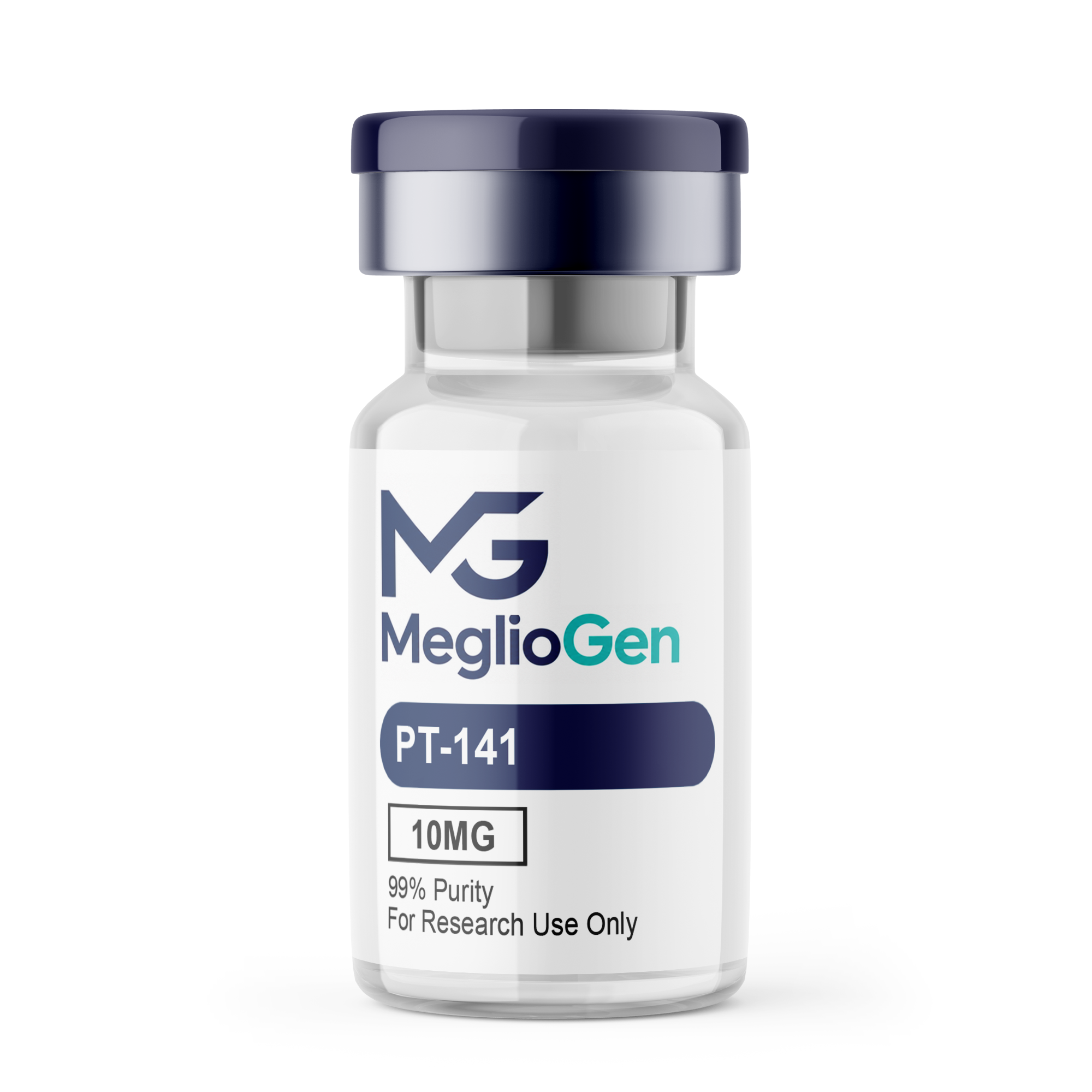
Although an FDA-approved prescription drug contains bremelanotide as its active ingredient, the PT‑141 10mg research product described here is not an FDA-approved drug or pharmaceutical formulation. Similarity in molecular identity does not establish pharmaceutical equivalence, sterility, bioavailability, manufacturing equivalence, safety, or suitability for clinical use.
All product information is provided strictly for laboratory, analytical, and educational purposes.
Biochemical Characteristics
PT‑141 is a synthetic cyclic heptapeptide related to the melanocortin peptide family. Its cyclic structure was developed to produce greater metabolic stability and distinct receptor activity compared with naturally occurring linear melanocortin peptides.
PT‑141 is derived from melanotan II-related research but does not share an identical experimental profile. Its activity has been studied primarily at MC3R and MC4R, although activity at additional melanocortin-receptor subtypes may depend on assay design and experimental concentration.
Activation of melanocortin receptors commonly initiates G protein-mediated signaling. In many experimental systems, this includes activation of adenylate cyclase and changes in intracellular cyclic adenosine monophosphate—cAMP. Downstream responses vary according to receptor subtype, tissue distribution, ligand concentration, and experimental model.
Product Characteristics
- Product Name: PT‑141 10mg
- Alternative Name: Bremelanotide
- Molecular Class: Synthetic cyclic melanocortin peptide analog
- Peptide Length: Seven amino-acid residues
- Sequence Representation: Ac‑Nle‑cyclo[Asp‑His‑D‑Phe‑Arg‑Trp‑Lys]‑OH
- Primary Research Targets: MC3R and MC4R
- Molecular Formula: C₅₀H₆₈N₁₄O₁₀
- Approximate Molecular Weight: 1,025.2 g/mol for the unsalted molecular entity
- Quantity: 10mg
- Material Form: Research-grade peptide material
- Purity: Refer to the batch-specific Certificate of Analysis
- Intended Use: Laboratory research only
- Regulatory Status: This research product is not an FDA-approved drug
Reported molecular weight may vary depending on salt form, counterion, residual water, and batch-specific material characteristics. Researchers should rely on the corresponding Certificate of Analysis for definitive identity and composition.
Research Applications
Within scientific literature, PT‑141 has been evaluated as a melanocortin-receptor agonist in controlled laboratory, animal, and clinical-research settings.
Documented research contexts include:
- Melanocortin receptor-binding assays examining receptor affinity, selectivity, activation, and concentration-dependent responses.
- MC3R and MC4R signaling studies evaluating receptor-mediated changes in intracellular cAMP and downstream cellular activity.
- Central nervous system research examining melanocortin-responsive neuronal populations and hypothalamic signaling.
- Behavioral research models evaluating centrally mediated responses following melanocortin-receptor activation.
- Autonomic signaling studies investigating neurological pathways associated with physiological arousal and vascular responses.
- Comparative ligand research evaluating PT‑141 alongside α‑MSH, melanotan II, or other melanocortin-receptor agonists and antagonists.
- Neuronal activation studies examining markers such as c‑Fos immunoreactivity in specific regions of experimental animal brains.
- Pharmacokinetic research evaluating peptide absorption, distribution, metabolism, elimination, and exposure relationships in controlled studies.
- Receptor-selectivity investigations comparing activity across MC1R, MC2R, MC3R, MC4R, and MC5R systems.
- Structure–activity relationship studies examining how cyclization and amino-acid substitutions affect melanocortin-receptor activity.
All referenced applications are presented as research contexts and do not constitute recommendations for clinical or personal use.
Pathway / Mechanistic Context
PT‑141 is studied primarily as an agonist of melanocortin receptors within the central nervous system.
The melanocortin receptor family includes five recognized G protein-coupled receptor subtypes:
- MC1R
- MC2R
- MC3R
- MC4R
- MC5R
PT‑141 research has focused especially on MC3R and MC4R. These receptors are expressed in neuronal regions involved in behavioral, autonomic, metabolic, and endocrine regulation.
In compatible experimental systems, receptor activation may initiate G protein signaling, activate adenylate cyclase, increase intracellular cAMP, and alter downstream kinase or transcriptional pathways. The magnitude and nature of these responses depend on receptor subtype, cellular environment, ligand concentration, exposure duration, and assay conditions.
Animal research has also examined c‑Fos expression as an experimental marker of neuronal activation following PT‑141 exposure. Observed activity in hypothalamic and related neural regions contributed to investigation of centrally mediated melanocortin pathways.
PT‑141 is mechanistically distinct from compounds that act primarily through direct phosphodiesterase inhibition or localized nitric-oxide-dependent vascular signaling. Nevertheless, the complete relationship among melanocortin activation, autonomic responses, vascular changes, and behavior remains dependent on the model being studied.
Mechanistic observations cannot independently establish therapeutic efficacy, safety, or appropriate use of an unapproved research formulation.
Preclinical Research Summary
Early animal investigations evaluated PT‑141-related melanocortin signaling in rats and nonhuman primates. These studies examined behavioral and physiological responses associated with activation of central melanocortin pathways.
Researchers also evaluated neuronal activation through changes in c‑Fos immunoreactivity within specific regions of the hypothalamus. These findings supported the hypothesis that PT‑141 produces activity through central melanocortin-receptor pathways rather than exclusively through peripheral vascular mechanisms.
Subsequent receptor studies identified activity involving MC3R and MC4R. Because melanocortin receptors are distributed across multiple tissues and neuronal populations, experimental responses may vary substantially according to receptor expression, species, exposure level, and study design.
PT‑141 has also been evaluated in controlled human clinical research, and a prescription bremelanotide product received FDA approval for a specific indication and population. However, that approval applies exclusively to the authorized pharmaceutical product manufactured under its approved specifications.
It does not establish the safety, legality, equivalence, or clinical suitability of independently sold research-grade PT‑141.
Research involving PT‑141 10mg as an RUO material does not establish:
- Pharmaceutical equivalence
- Sterility or suitability for administration
- An appropriate human dose
- Safety for self-directed use
- Suitability for male or female sexual dysfunction
- Suitability for cardiovascular or neurological conditions
- Long-term safety
- Compatibility with other substances
- Therapeutic or preventive value
The product must remain confined to controlled laboratory-research environments.
Form & Analytical Testing
PT‑141 10mg is supplied as a research-grade synthetic peptide material. Identity, purity, net peptide content, counterion, and other batch characteristics should be documented through appropriate analytical testing.
Applicable analytical methods may include:
- High-Performance Liquid Chromatography — HPLC: Used to evaluate chromatographic purity and detect selected peptide-related impurities.
- Liquid Chromatography–Mass Spectrometry — LC‑MS: Used to support molecular identity by examining mass-to-charge characteristics.
- Mass spectrometry: Used to compare the observed molecular mass with the expected PT‑141 molecular entity.
- Peptide mapping: May be used to support sequence identity and detect selected sequence-related variants.
- Amino-acid analysis: May help evaluate peptide composition and content.
- Counterion analysis: Used to identify or quantify acetate, trifluoroacetate, or another associated counterion when applicable.
- Water-content analysis: Used to determine residual moisture that may contribute to total material mass.
- Residual-solvent testing: Used to evaluate selected solvents potentially remaining from peptide synthesis.
- Microbial or endotoxin testing: Applicable only when specifically performed and documented for the individual batch.
Chromatographic purity does not independently establish sterility, potency, pharmaceutical quality, or suitability for administration. A stated vial quantity may represent total material mass or net peptide content depending on the manufacturer’s testing methodology.
Researchers should consult the complete batch-specific Certificate of Analysis before designing or interpreting an experimental protocol.
Referenced Citations
- Molinoff PB, et al. (2003). PT‑141: A melanocortin agonist for the treatment of sexual dysfunction. Annals of the New York Academy of Sciences. PubMed | DOI
- Diamond LE, et al. (2004). Double-blind, placebo-controlled evaluation of the safety, pharmacokinetic properties and pharmacodynamic effects of intranasal PT‑141. International Journal of Impotence Research. PubMed search
- Diamond LE, et al. (2006). An effect on the subjective sexual response in premenopausal women with sexual arousal disorder by bremelanotide. Journal of Sexual Medicine. PubMed search
- Pfaus JG, et al. (2004). Selective facilitation of sexual solicitation in the female rat by a melanocortin receptor agonist. Proceedings of the National Academy of Sciences. PubMed search
- Clayton AH, et al. (2016). Bremelanotide for female sexual dysfunctions in premenopausal women: A randomized, placebo-controlled dose-finding trial. Women’s Health. PubMed search
- Kingsberg SA, et al. (2019). Bremelanotide for the treatment of hypoactive sexual desire disorder: Two randomized Phase 3 trials. Obstetrics & Gynecology. PubMed search
- U.S. Food and Drug Administration. Vyleesi—Bremelanotide Injection Prescribing Information. FDA label
ALL ARTICLES AND PRODUCT INFORMATION PROVIDED ON THIS WEBSITE ARE FOR INFORMATIONAL, EDUCATIONAL, AND LABORATORY-RESEARCH PURPOSES ONLY. THEY ARE NOT INTENDED TO PROVIDE MEDICAL OR VETERINARY ADVICE.
RUO Disclaimer
PT‑141 10mg is offered strictly for laboratory, analytical, and scientific research purposes.
Although bremelanotide exists as an FDA-approved prescription medication, this research-grade PT‑141 product is not the approved pharmaceutical product. It has not been manufactured, evaluated, authorized, or dispensed as a prescription drug.
The existence of an approved bremelanotide medication does not make independently supplied PT‑141 interchangeable with that medication. It does not establish equivalent purity, sterility, formulation, concentration, stability, bioavailability, manufacturing controls, or clinical safety.
This material is not intended for:
- Human consumption or administration
- Veterinary use
- Compounding
- Self-experimentation
- Cosmetic application
- Diagnosis or clinical testing
- Treatment, mitigation, cure, or prevention of disease
- Substitution for an approved prescription product
For Laboratory Research Use Only (RUO). Not for human or veterinary use.
Reviews
There are no reviews yet.